
A curling leaf is a plant managing water. When a leaf loses water faster than the roots can deliver it, or the roots cannot deliver any, the leaf changes shape. The direction of the curl, the dampness of the soil and which leaves are affected narrow the cause quickly, usually faster than guessing at fixes.
Read the curl in three questions
- Which way does it curl? Up or inward points one way, down points another (figure below).
- How wet is the soil? Push a finger or skewer 3 cm down. This answers more than the direction does.
- Which leaves? Only the newest, only the oldest, or all of them.
Cupped up
Thirst, heat, strong light
Soil usually dry
Rolled inward
Dry air or thirst
Soil dry or damp
Curled down
Wet roots, cold, salts
Soil usually wet
Twisted new leaves
Thrips, aphids, mites
Soil can be any
Direction is a clue, not a verdict. The same plant can curl either way depending on what is wrong, which is why the soil check carries the decision.
Curling up or inward: thirst, heat, dry air or roots
Leaves that cup upward or roll in at the edges are usually cutting their exposed surface to slow water loss.
- Thirst. The soil is dry deep down, the pot feels light and the mix may have shrunk from the pot wall so water runs straight through. Soak it properly: stand the pot in a few centimeters of water for 15 to 20 minutes, as in our bottom watering guide, then let it drain. Our watering calculator can set a sensible interval.
- Dry air and heat. A leaf near a radiator, a heating vent or a sun-baked windowsill loses water faster than the roots can supply. Move it back and raise the humidity; humidity for tropical plants covers what works and what does not.
- Too much light. Curling on the sun-facing side, sometimes with bleached patches, means the glass is too hot or too bright. Pull the plant back or filter the light; see what bright indirect light means.
- Roots with no room. A plant that wilts and curls within days of every watering may be root-bound: roots circle the pot and little soil is left to hold water.
Curling down: wet roots, cold or salts
- Overwatering. Roots in waterlogged soil cannot take up water, so leaves lose pressure and droop or curl down even though the soil is wet. Check for a sour smell and a soft base, and read the overwatering signs and the root rot guide. An oversized pot holds more water than the roots can use, which produces the same picture.
- Cold. Leaves near cold glass or an air conditioner vent curl down and may feel cool. Move the plant away from the draft.
- Fertilizer or mineral salts. A white crust on the soil or pot rim, with brown edges, points to salt buildup. Flush the pot with plain water and ease off feeding; see fertilizer basics and tap water and houseplants.
Only the new leaves are twisted or puckered
When the damage is confined to new growth, suspect a sap-sucking pest: thrips (silvery streaks), aphids (clusters and sticky residue) or mites (fine stippling and webbing). Tap a leaf over white paper, look at the undersides with a magnifier and check for sticky leaves. Isolate the plant, rinse the foliage, and treat repeatedly, because eggs survive a single spray. Our pest identification guide has the details.
New leaves also emerge rolled and unfurl over several days. That is normal growth, not a problem, so only worry if they stay twisted after opening.
When curling is normal
- Prayer plants and calatheas raise and fold their leaves at night, controlled by a small joint at the leaf base called a pulvinus. If the leaves are flat again by morning, nothing is wrong. See calathea care for what to do when they stay curled in daylight.
- Hot afternoons. Some plants curl slightly at the hottest hour and recover by evening.
The diagnosis in one chart
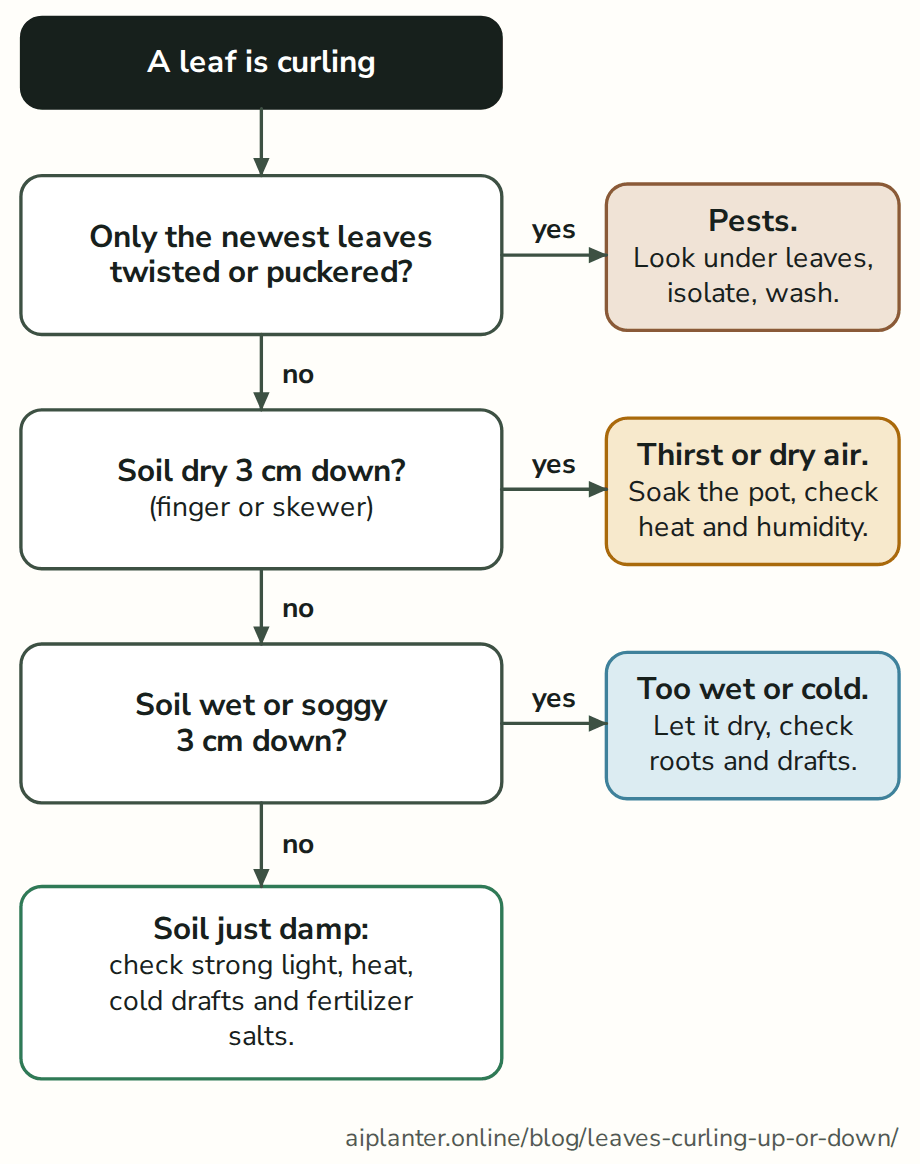
Read this figure as text
- A leaf is curling. First ask: are only the newest leaves twisted or puckered? Yes: suspect pests. Look under the leaves, isolate the plant and wash it.
- Otherwise push a finger or skewer 3 cm into the soil. Dry: thirst or dry air. Soak the pot, then check heat and humidity.
- Soil wet or soggy 3 cm down: too wet or cold. Let it dry out, check the roots and move it away from drafts.
- Soil just damp: check strong light, heat, cold drafts and fertilizer salts next.
Every cause at a glance
| Cause | Usual direction | How to confirm | Fix |
|---|---|---|---|
| Thirst | Up or inward | Soil dry deep, pot light, soil pulling from the edge | Soak thoroughly, then water on a steady schedule |
| Dry air or heat | Up or inward, crisp edges | Soil fine; plant near a vent, radiator or hot glass | Move it, add humidity |
| Too much light | Up, on the sunny side | Bleached or scorched patches facing the window | Pull back or add a sheer curtain |
| Root-bound | Up, plus wilting | Roots circle the pot or poke from the holes | Repot one size up |
| Overwatering | Down | Soil wet 3 cm down, sour smell, soft base | Let it dry, check the roots, fix drainage |
| Cold draft | Down | Sudden onset near cold glass or an AC vent | Move it somewhere stable |
| Salt buildup | Down, brown edges | White crust on soil or pot rim | Flush with plain water, reduce feeding |
| Pests | Twisted new growth | Sticky residue, stippling, silvery streaks, webbing | Isolate, wash, repeat treatment weekly |
Fix it in this order
- Check the soil first. Finger, skewer or lifting the pot. Everything else depends on this result.
- Correct the water. Soak a dry pot; let a wet one dry out before the next drink.
- Fix the surroundings. Move away from heat, cold glass and vents; adjust light and humidity.
- Check the roots and undersides. If the soil check was not decisive, slide the plant out, and turn leaves over for pests.
- Judge by new growth. Leaves that have been curled for weeks often stay that way. A few weeks later, healthy flat new leaves mean the fix worked. Trim only leaves that have fully crisped.
Frequently asked questions
Why are my plant's leaves curling inward?
Inward or upward curling usually means the plant is conserving water: the soil is dry, the air is hot or dry, or the light is too strong. Push a finger 3 cm into the soil first. Dry soil points to thirst; damp soil points to heat, dry air or light.
Why are my leaves curling down after watering?
Roots in soggy soil cannot absorb water, so leaves lose pressure and droop or curl down even though the soil is wet. Check that the soil is wet 3 cm down, let it dry, make sure the pot drains, and inspect the roots for rot.
Will curled leaves flatten out again?
Mild curls from thirst or low humidity often relax within days once you fix the cause. Leaves curled for weeks, or that have crisped, usually stay as they are. Judge recovery by the new growth that follows.
Why do prayer plant leaves curl at night?
That is normal. Prayer plants and calatheas raise and fold their leaves at night using a small joint at the base of each leaf, then open again in the morning. Worry only if they stay curled all day.
Can low humidity alone make leaves curl?
Yes, especially on tropical plants such as calathea. Soil that is properly damp with curling and crisping edges suggests dry air or heat rather than thirst.